


The strategic role of IT in Consumer Products

In today's competitive consumer products landscape — spanning CPG, food and beverage, and specialty chemicals — IT is now a critical enabler of business success.

Digital and technology leaders are expected to do more than maintain systems, and are responsible for delivering with agility, accelerating compliance, and enabling innovation. Business applications that combine data across functions, such as quality, are increasingly drivers of productivity and insights, helping organizations prepare for the era of AI.

IT Background

In this context, IT is a proactive partner in shaping quality strategy by:

  • Aligning digital capabilities with strategic goals
  • Delivering data when and where it's needed most
  • Empowering innovation through data visualization and AI-readiness

But delivering on this potential requires a fundamental shift from fragmented tools to integrated, scalable platforms.

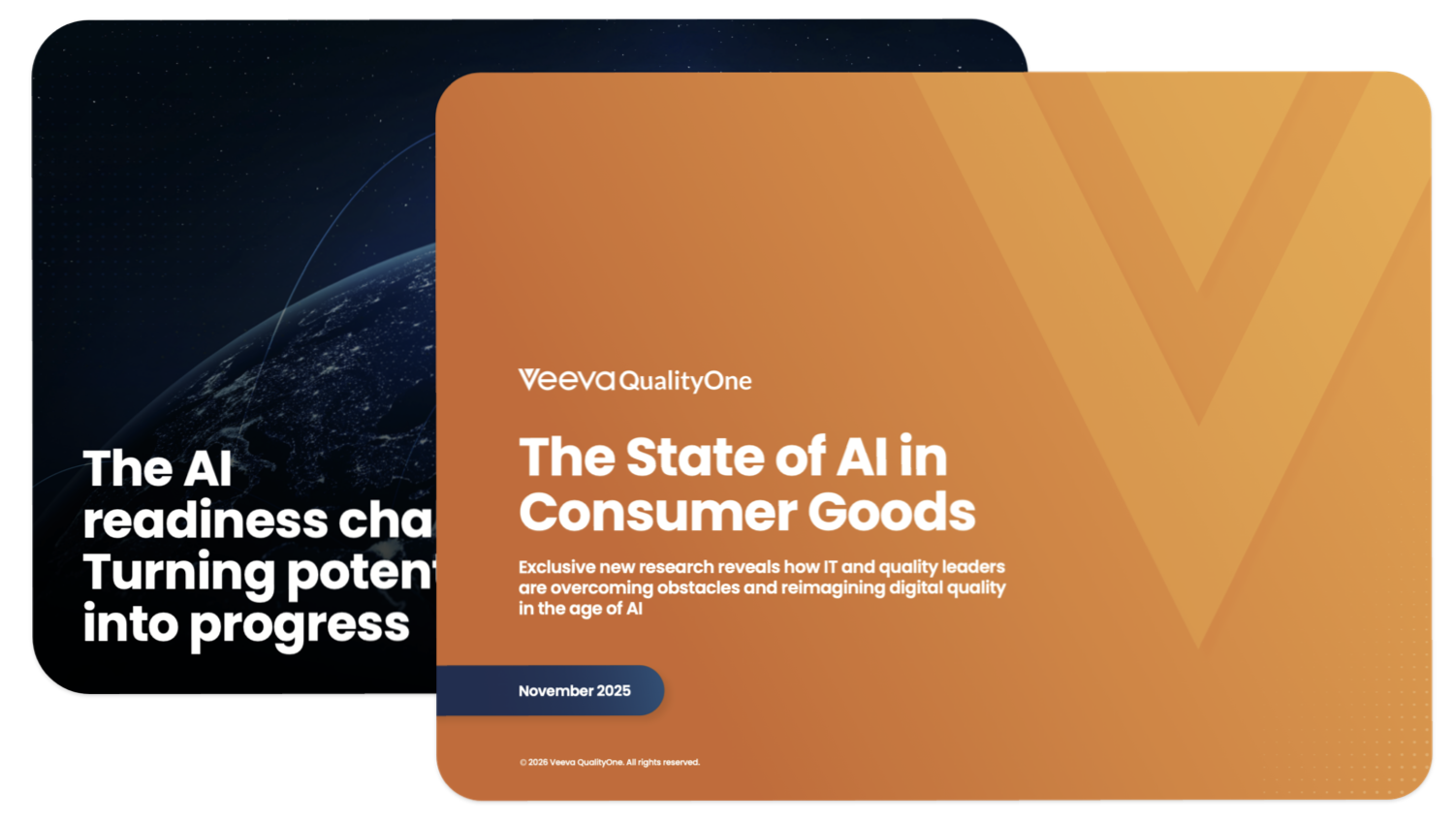
The State of AI in Consumer Goods

Exclusive new research reveals how IT and quality leaders are overcoming obstacles and reimagining digital quality in the age of AI.

Download the eBook

The State of AI in Consumer Goods

Simplifying the complex:
Consolidating legacy systems on a unified platform

Despite their ambitions, IT teams are often held back by technical debt, slow legacy systems, and the burden of maintaining integrations across disconnected applications. This is especially true within quality, where many organizations cling to outdated technology and practices.

Common IT Challenges

white angle

IT Opportunities

Too many siloed point solutions

orange angle

Simplification through a unified system

Inflexible legacy infrastructure

orange angle

Faster innovation via built-in integration capabilities

Reactive support model struggling to keep pace with business needs

orange angle

Centralized, trusted data as the foundation for AI

Fragmented data across departments and systems

orange angle

A product-focused mindset that keeps IT aligned with evolving business needs
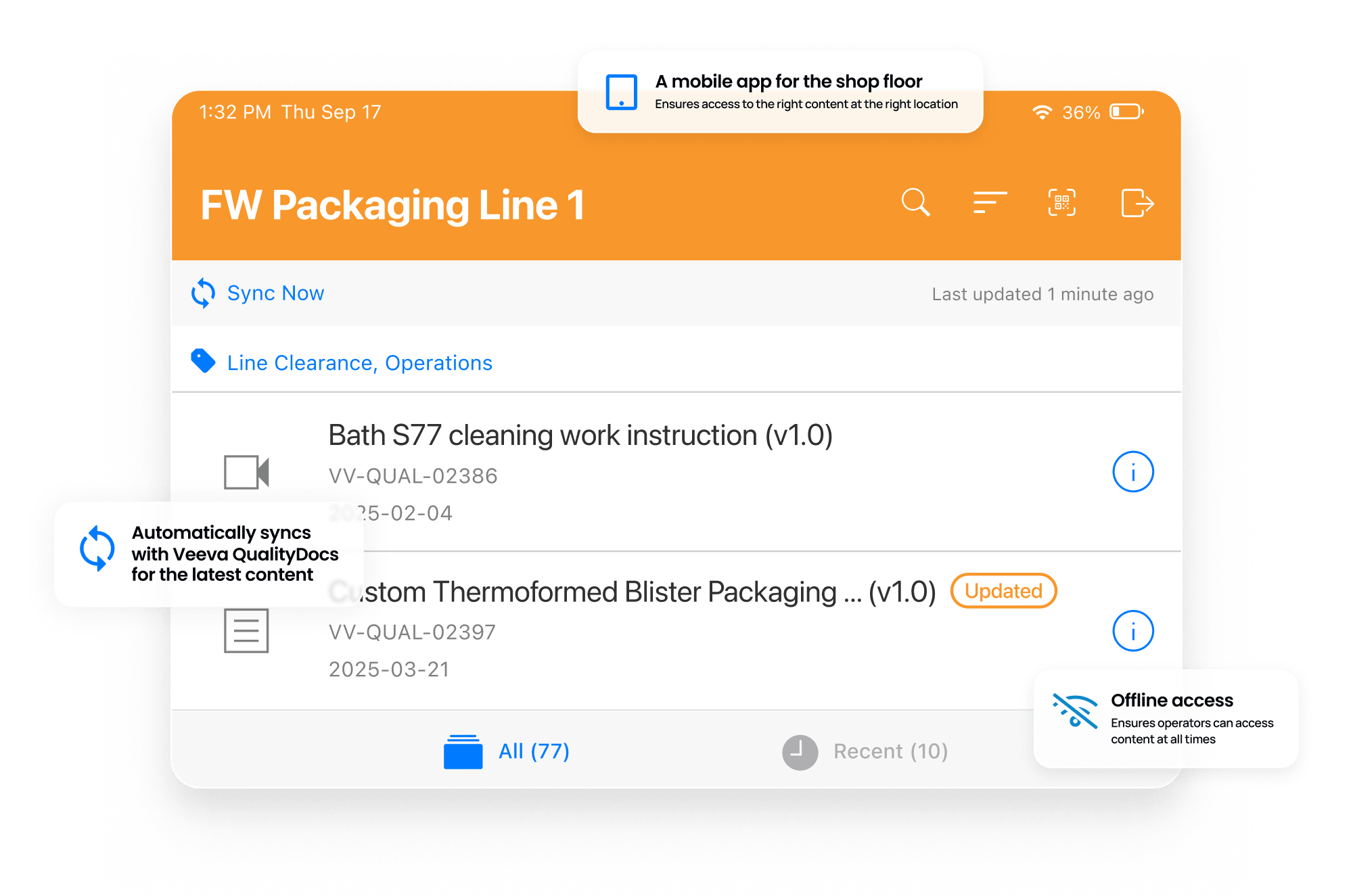
These challenges created by siloed legacy systems make it difficult for IT leaders to deliver with agility, accelerate compliance, and enable innovation. However, modern quality platforms enable IT to move faster and drive greater business value.

The Veeva QualityOne advantage for IT

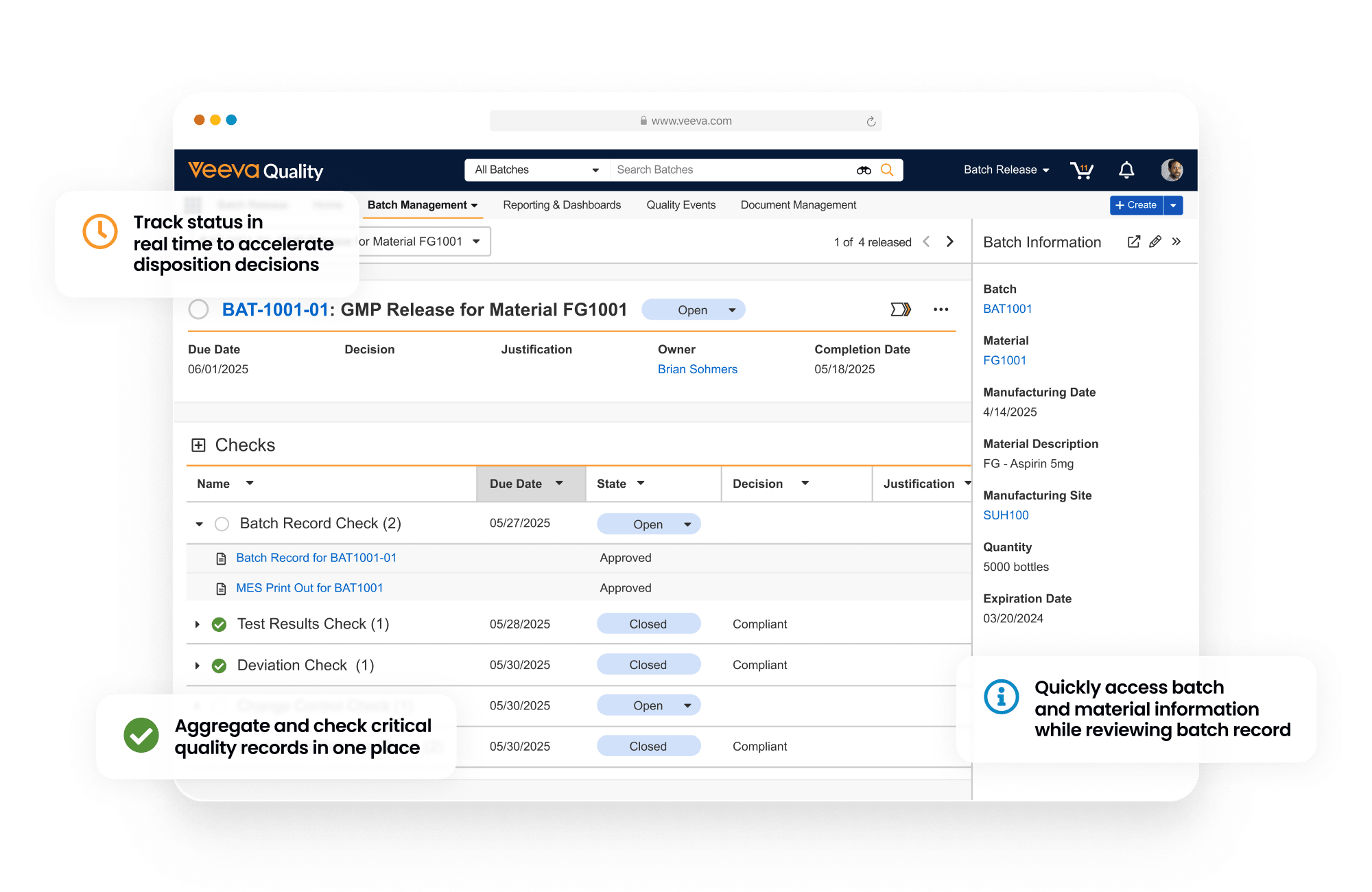
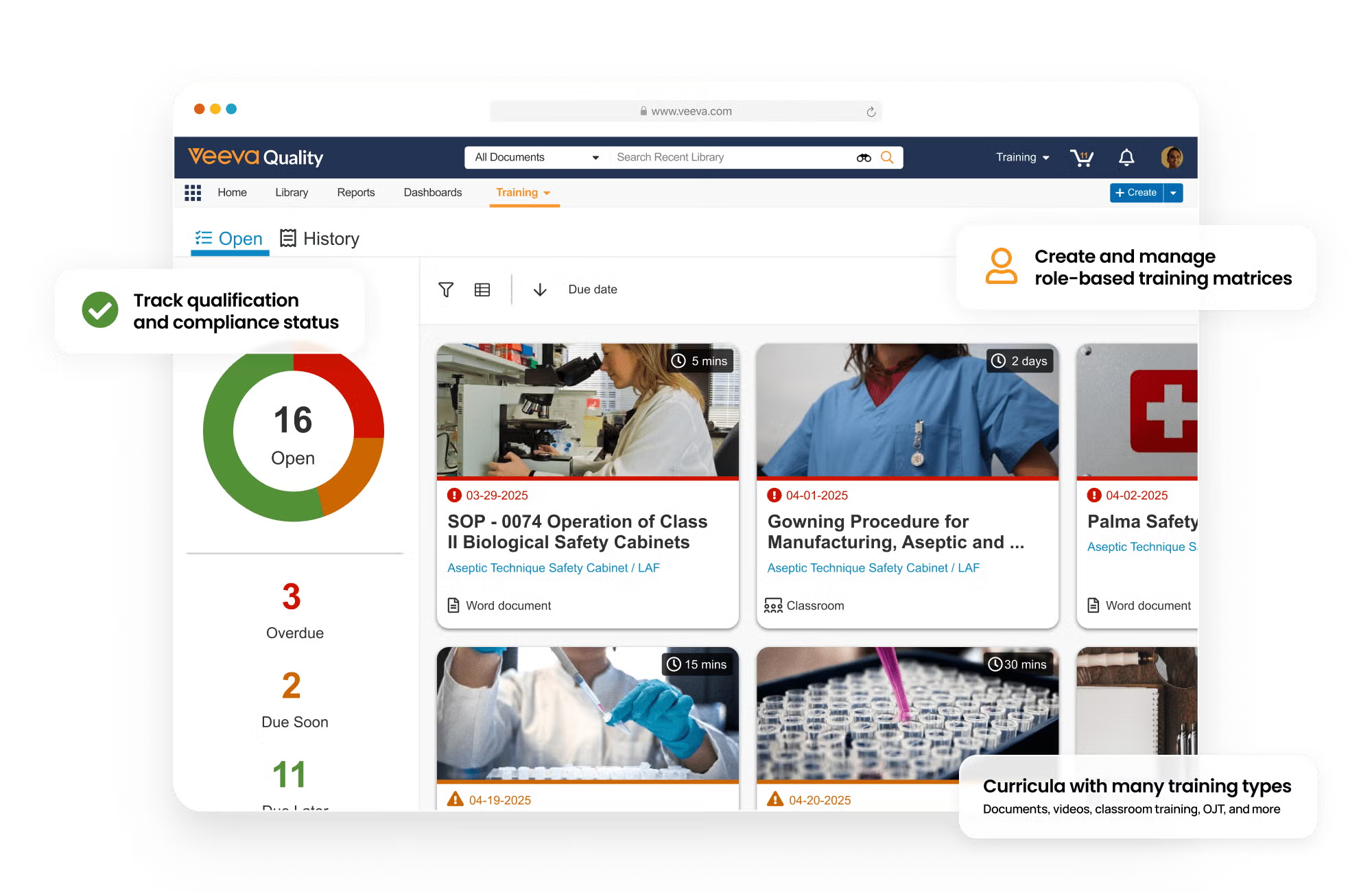
A quality management platform like Veeva QualityOne removes traditional silos by moving to a single platform unifying quality assurance (QA), quality control (QC), and training.

QualityOne empowers IT leaders by simplifying operations, integrating seamlessly with other systems, centralizing data access, and providing built-in compliance capabilities.

Connected digital ecosystem

Enables execution of all quality processes through strategic connections between applications. Open REST APIs and the Vault API Library (VAPIL) mean data flows seamlessly between QualityOne and external systems. This removes technical debt by ensuring lab results, document changes, and training records trigger automatic downstream actions without manual IT intervention.

Proactive compliance and traceability

Ensures a robust, audit-ready environment for GxP and non-GxP operations. Built-in automation — such as linking Veeva Training to QualityDocs revisions and aggregating batch data into Veeva Batch Release — support audit-readiness and faster market-ship decisions. Comprehensive audit trails mean there is full traceability of all decisions and actions.

Secure and scalable

Our multi-tenant, validated SaaS platform includes industry-leading security at every layer: physical, application, and network. Full data ownership, exportability for customers and scalability to support global operations, growth, and future workloads.

Unified data foundation for AI-enabled quality

Provides a standardized, common data foundation for advanced automation, predictive analytics, and agentic AI.

Low-code configuration

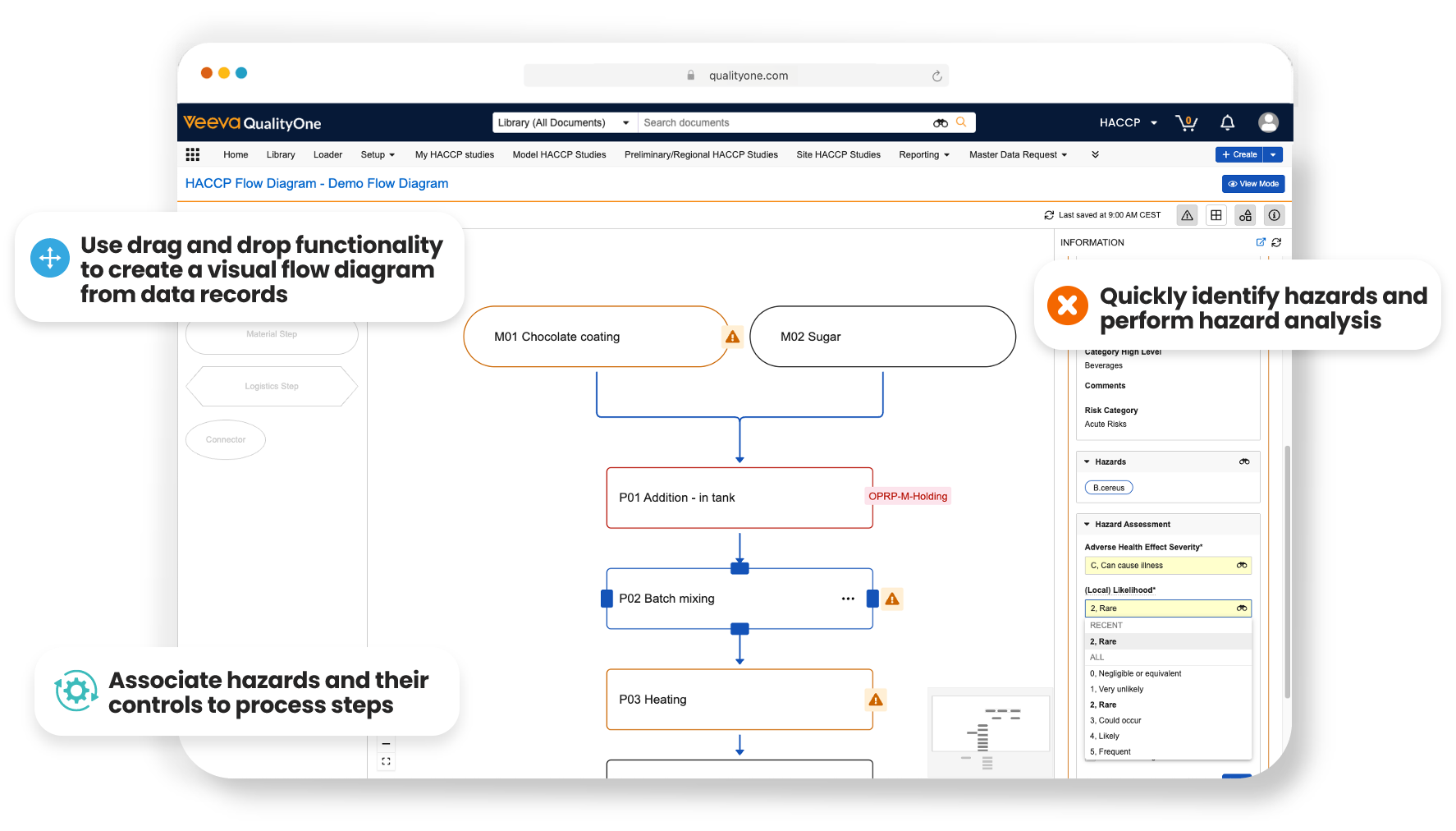
Administrators can tailor workflows and data models with drag-and-drop tools. More complex scenarios can be supported via internal “action trigger” automation, as well as custom SDKs — balancing agility with depth.

Increase IT's value to the business


Technology executives and decision makers in leading consumer products enterprises need business systems that build common ground, are integrated by design, and help both IT and the business move faster.


The Veeva Vault Platform integrates across:

Frequently Asked Questions

How does QualityOne contribute to my organization's readiness for artificial intelligence (AI)?

Veeva QualityOne provides a unified and secure data environment when applying AI. By consolidating data and documents on a single platform, customers benefit from consistent data taxonomies and integration capabilities, which are critical for training AI models.

How does Veeva QualityOne fit into my overall system architecture?

QualityOne enables critical business connections across your existing tech stack. It feeds into and augments other strategic business platforms, such as ERPs, PLMs, and CRMs, and supports modern integration patterns. Whether connecting to ingest master data sources or drive downstream execution, our open, REST-based APIs ensure seamless integration. The Veeva Professional Services team has extensive experience partnering with enterprise companies to build complex integrations that reduce technical debt.

How does Veeva ensure that our proprietary content and data are secure?

Data security is paramount for Veeva and our customers. Veeva protects customer data with world-class physical, network, application, and data-level security.

How do I get access to my content and data once it's stored in the platform?

Neither Veeva nor its processing partners has access to data stored within a customer's environment. Customers may use a range of tools to gain access to their data at any time. These include the ability to export data and content on a scheduled basis to flat files; an API layer to retrieve data in near-real time; and Vault Loader, a UI-based tool to facilitate export of data and content.

How scalable is Veeva QualityOne for a large enterprise environment?

Veeva offers significant scalability benefits for large enterprises. As a multitenant cloud platform, QualityOne can easily accommodate large numbers of users, larger datasets, and expanding business processes without compromising performance.

Does system configuration require any code?

QualityOne applications come pre-configured with domain-specific best practices, including workflow processes and document lifecycles. Additional business requirements and functionality can be achieved with simple drag-and-drop configuration via the administration user interface. More complex requirements are permissible via native SDK tools and coding; however, simplicity is a guiding principle for solutions.

How does the Veeva team handle data and content migration?

Most data and document migration scenarios can be handled by the Veeva Professional Services team, but for more complex or specialist data migrations, we engage our network of approved migration partners.

Do Veeva and its applications openly integrate with other systems?

Almost all our projects will be integrated with other systems, starting with single sign-on (SSO) up to fully bi-directional integrations with ERP systems and other typical master data sources. Integration with other systems may be achieved through the Vault open, REST-based API.

What is Veeva's implementation methodology?

Veeva employs an agile project methodology emphasizing configuration planning, rigorous scheduling, and continuous progress tracking. This approach ensures project agility, improves solution quality, and reduces risk.

What should I expect in terms of internal IT resourcing needed for a Veeva implementation for an upcoming project?

A typical implementation team includes:

  • IT support: Assists with system access and technical discussions.
  • System administrators: Identified closer to deployment to manage application changes.
  • Project management: Often led by the customer's Project Management Office (PMO) teams for overall coordination.
  • Migration lead: Responsible for identifying content, planning the migration, and populating templates.
What type of post-go-live support do you offer?

Veeva provides 24/7/365 product support at no additional cost as part of the Veeva license subscription fee. Other options include Post Go-live Configuration Services (Managed Services), Technical Managed Services for code-heavy environments, and Product Education advisors.

How often does Veeva release platform and application updates? How do we handle upgrades? Do we need to do anything?

We update applications three times per year, or approximately every 120 days. Veeva customers benefit from instant deployment of new versions, meaning the entire customer base is always working on the latest version. Customers have access to a pre-release environment for several weeks in advance to allow for testing.

Interested in learning more
about how Veeva can help?

Contact Us white angle arrow

veeva logo